Domestic violence and the rights of abused women
The Drover's WifeDomestic violence and the rights of abused women are central to the novel’s account of how private violence becomes a public question of law, evidence, and voice. Molly Johnson’s repeated abuse by Joe Johnson, her husband, is not treated as an isolated quarrel: it shapes her daily movements, threatens her during pregnancy, and culminates in her killing him as he advances on her. The aftermath reveals a second danger: although Nate Clintoff and Louisa Clintoff recognize the context of her actions, the legal process proceeds without the testimony needed to make that context count. Louisa’s protest turns Molly’s case into a demand for rights that will reach women beyond the courtroom.
Abuse, Isolation, and Pregnancy
The novel shows Joe’s control through the constraints he imposes on Molly’s ordinary actions. At six months pregnant, she remains seated because he has laid his leg across her lap; she fears that moving will provoke him to strike her abdomen. Earlier that night, when she tries to rise to attend to one of the children, Joe grips her arm and pulls her back. He also repeatedly headbutts her, a form of assault she dreads because she cannot anticipate or brace for it. The scene makes clear that abuse operates not only through individual blows but through the threat that governs whether Molly may move at all.
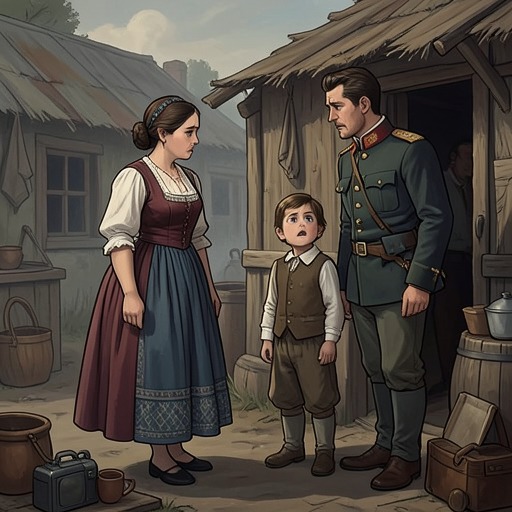
The children’s presence intensifies the danger without giving Molly meaningful protection. Danny lies awake, wishing his father would go to sleep, and watches through a crack in the wall. Joe is drunk, breaks a whiskey bottle against the chopping block, and approaches Molly with a shard. Molly pleads with him to think of the children, while Danny, frightened by what he sees, urges her to shoot. The account places the violence inside family life, where children witness it and where Molly’s appeals to motherhood do not restrain the attacker.
Pregnancy and childbirth also expose Molly’s vulnerability to the conditions of her isolation. Elsewhere, about eight months pregnant and washing clothes by the river, she has to pause because her back hurts; even this ordinary work is shaped by physical strain. Later, when labor begins unexpectedly and she realizes the baby is presenting feet first, she faces the emergency without medical help. The black stranger offers assistance, but Molly fears that allowing a black man to touch a white woman will itself be treated as transgression. Her predicament joins reproductive danger to racial rules and the absence of safe support. After the difficult birth and the stillbirth of her daughter, Molly is unwell and needs help caring for her surviving children.
Self-Defense and Unequal Vulnerability
Molly’s killing of Joe follows an established pattern of abuse and the immediate threat Danny witnesses. The novel’s account places her bruised and frightened before the approaching man, who is carrying broken glass and moving toward her. Her plea that he consider the children fails; Danny’s warning comes as the threat reaches its crisis. This sequence makes the killing intelligible as a desperate response to violence, even as the legal system later treats it as a crime to be judged apart from the history that produced it.
The novel sets Molly’s vulnerability alongside the racialized danger facing Yadaka, the fugitive who helps her after the birth. When Molly questions why he wears an iron collar, he answers that his crime is simply existing while black. She understands that Aboriginal people in the region are blamed, imprisoned, driven away, or exposed to an unofficial permission for whites to shoot them. Molly’s own fear that an injured stranger might bring troopers to her door shows how the law and its agents enter the household as a threat rather than a dependable source of protection. Her situation is distinct from Yadaka’s, but the novel links both to a social order that distributes safety and credibility unequally.
The danger to the children extends that inequality into the next generation. Miss Shirley labels them octaroons and tells Judge Eisenmangher that they need urgent help; the judge signs an authorization for their removal. Danny’s inward response questions the claim that the intervention is for their benefit. The proposed removal reveals that Molly’s family faces not only the consequences of domestic violence and poverty but also racial classification backed by official authority. The legal response can therefore threaten the mother-child bond even while claiming to act for children’s safety.
Law, Evidence, and the Limits of Recognition
Nate, the new peacekeeper of Everton, is caught between his understanding of Molly’s circumstances and his official duty. He later recognizes that her act may have been the desperate response of a deeply wronged woman, but believes he cannot simply disregard the law. At trial, the all-male jury hears Miss Shirley’s account of Molly’s mixed heritage and a prosecution argument that attributes her actions to inherited racial hatred, knowledge of her ancestry, and Yadaka’s influence. That framing recasts the history of abuse as a racial motive and presents Molly’s actions through the authority of the men who prosecute her.
The absence of a witness capable of telling Molly’s story is decisive. Danny, the only witness Nate identifies as able to speak to the truth of what happened, is missing. Nate knows the hearing is biased but believes he can do nothing to change it. Louisa points to a further problem: Molly has recently given birth, lost a child, and fears for her other children, yet no doctor has examined her or her mental state. Nate answers that the evidence against her is overwhelming and cites what he saw; Louisa insists that her battered condition matters to the interpretation of the act. Their disagreement is not over whether Molly killed a man, but over whether the circumstances and accumulated abuse can be heard as evidence rather than dismissed as irrelevant.
Louisa’s argument is sharpened by her own family history: her sister died at the hands of her husband, a man regarded as a gentleman. She is lobbying for legislation to help battered wives, but recognizes it cannot pass in time to save Molly. Her reform work thus occupies an uneasy position between immediate failure and future possibility. She cannot secure a different outcome for Molly through the process as it stands, but she continues to press for protections that may help other women.
Voice, Advocacy, and the Ending
Louisa also tries to make women’s experience legible through writing. In the jail, she explains that she has been trying to give voice to an issue long kept silent and to give women a voice. Molly answers that she could hear only Louisa. The exchange unsettles the reformer’s confidence: speaking on behalf of women is not the same as allowing a woman to be heard on her own terms. The scene makes voice a matter of power and representation, not merely sympathy.
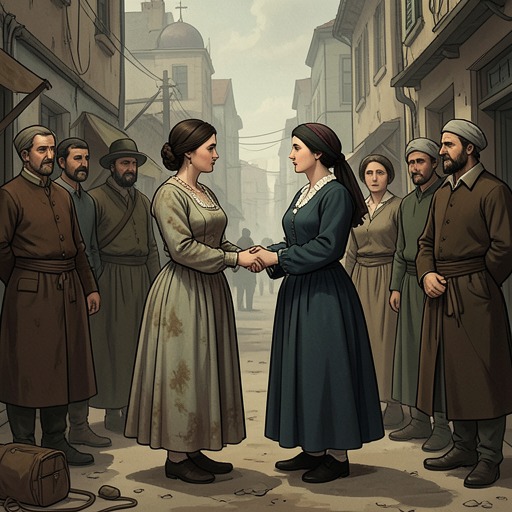
As Molly awaits execution, Louisa and two other women remove their capes to reveal protest messages written on their aprons, demanding that battered wives be heard and that women’s rights be legislated. They join hands and step forward despite the men’s disapproval. Nate is moved by his wife’s courage, yet remains in his appointed position as Everton’s law officer; he gives the final nod that permits the execution to proceed. The contrast between protest and official procedure shows the limits of private compassion when it does not alter institutional power.
Molly’s case ends without the legal recognition Louisa seeks. The novel nevertheless connects the public protest to the possibility of change: Nate believes that Louisa’s campaign may help others, even though it cannot act in time for Molly. By following the movement from domestic control, through the missing witness and contested trial, to the women’s visible protest, the novel treats abused women’s rights as inseparable from the right to safety, credibility, and a voice in the law that judges them.